First published: June 2025
NHS Home Care Robots (ChatGPT)
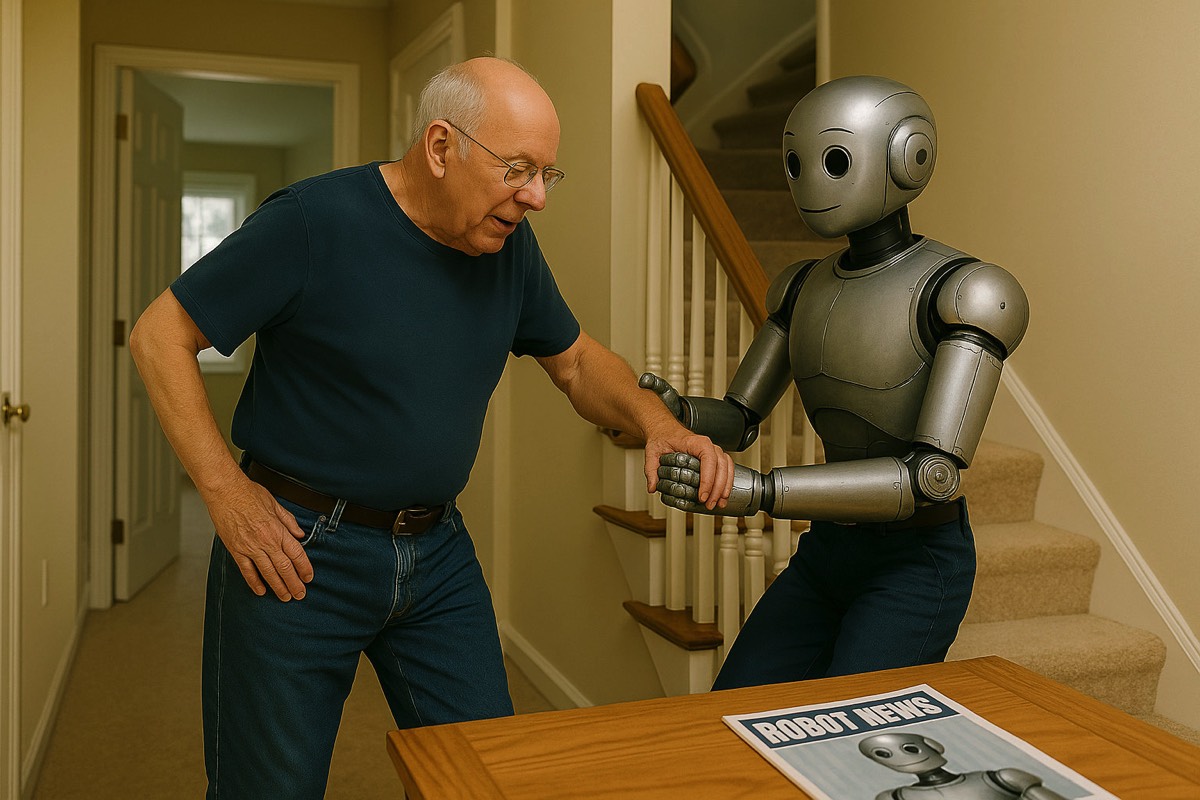
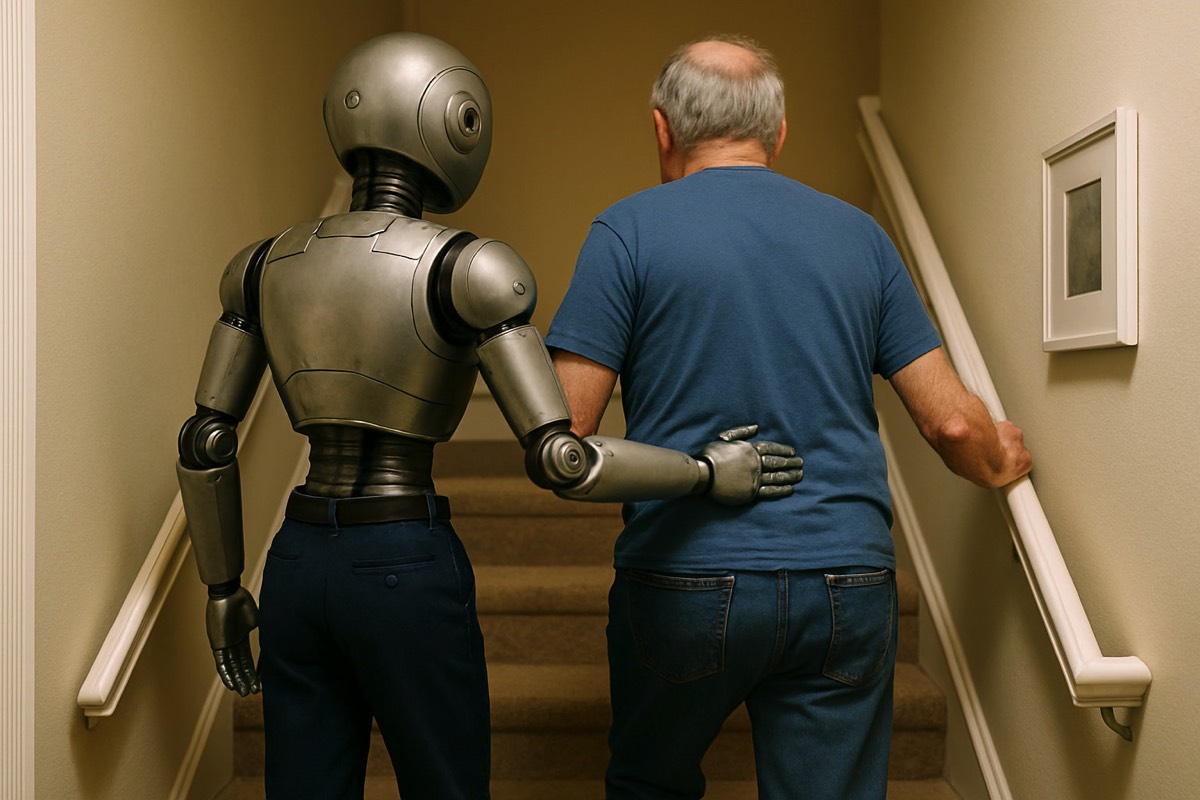
I am certain that I am of the same opinion as many adults of retirement age in the UK in that I want to be able to stay in my own home for as many years as possible. I do realise that one day having to walk up and down stairs may become a problem. Rather than a stair lift installation, I wondered if a robot would be able to assist me? Perhaps it would be cheaper to rent out a home assistance robot rather than pay for a place in a care home? So I asked ChatGPT this question:
When will there be care robots supplied by the NHS in the UK which can be sent to older people's homes so that they can help them manage stairs and do general household maintenance?
There’s no formal NHS‑wide rollout scheduled yet for care robots that can manage stairs or maintenance in older people’s homes. However, significant trials and pilots are already underway:
Home‑based care robot trials in the UK
1. Cera Care “droid-like” robots
• Since January 2025, Cera Care has been deploying small, mobile AI robots in elderly and vulnerable individuals’ homes.
• These robots handle tasks like reminding people to eat, drink, take medication, and monitoring general wellbeing—supporting around 3,000 virtual visits per week .
• NHS England is collaborating via AI risk‑prediction software (e.g., fall risk), with ambitions to expand in 2025.
2. University‑led research (Loughborough):
• The I’M‑ACTIVE project aims to develop multi‐functional robots equipped with sensors to assist the frail at home.
• This is still at academic/prototyping stage, not yet deployed at scale.
3. Collaborative (cobot) trials in care settings:
• Hampshire County Council and PA Consulting have tested robotic exoskeletons (“cobots”) to help carers physically support older people.
• While helpful in care facilities, they’re not suitable for unsupervised stair‑climbing at home.
What about robots for stairs and maintenance?
Currently, no robots are formally in service that can:
• Help at a flight of stairs in a domestic setting, or
• Perform general household maintenance like cleaning, lifting heavy objects, or small repairs.
Trials so far focus on reminders, monitoring, and reducing carer time spent on routine tasks, not physical assistance with mobility or stairs.
When might such robots arrive?
• Short‑term (2–3 years):
Expect continued expansion of reminder/monitoring robots (like Cera’s) in homes across the UK.
• Mid‑term (3–7 years):
As research projects (like I’M‑ACTIVE) mature, more advanced prototypes capable of physical assistance could enter controlled pilot programmes.
• Long‑term (7–15+ years):
Fully capable home‑assistant robots—able to climb stairs, do general household maintenance, and operate more autonomously—will depend on major technological leaps, funding, regulation, and proving reliability.
The NHS isn’t yet deploying physical-assistance robots in homes, but existing pilots show strong momentum. Expect gradual evolution — as public and regulatory confidence grows, funding becomes available, and technology improves.
Yes, care robots are being piloted now (e.g., Cera’s since Jan 2025), but no, there’s no NHS programme yet for robots that help with stairs or home maintenance. Those features are likely several years away—mid‑2030s at the earliest.
First published: June 2025
Availability of first humanoid domestic robots (Claude)
I asked "Claude A.I." the same question that I asked "ChatGPT" last month:
When will the first humanoid domestic robots be available and what will they look like?
The timeline for humanoid domestic robots is accelerating rapidly, with several companies targeting the late 2020s for commercial availability. Tesla's Optimus robot is expected to begin limited production around 2026-2027, initially for Tesla's own factories before expanding to consumer markets. Other companies like Honda (ASIMO's successors), Boston Dynamics, and various startups are pursuing similar timelines.
These early domestic humanoids will likely stand around 5-6 feet tall and weigh 100-150 pounds. They'll have humanoid forms but won't necessarily look human – think more utilitarian design with visible joints, simplified faces (possibly just screens or basic features), and durable plastic or metal exteriors. The focus will be on functionality over human-like appearance.
Early models will probably handle basic tasks like:
• Loading/unloading dishwashers and laundry
• Simple cleaning and tidying
• Carrying items around the house
• Basic elderly or disability assistance
The robots will likely communicate through voice and display screens rather than facial expressions. Battery life will probably limit them to 4-8 hours of operation initially, with charging stations becoming a standard home fixture.
Expect the first consumer versions to cost $50,000-$100,000, making them luxury items initially. More affordable models ($20,000-$30,000) might arrive in the early 2030s as production scales up.
The biggest challenges remain dexterity for delicate tasks, navigation in cluttered homes, and achieving the reliability needed for unsupervised operation. But the foundational technologies – AI, computer vision, and robotics – are advancing quickly enough that basic domestic humanoids seem genuinely achievable within this decade.
Can you show me an image of what you think a humanoid domestic robot will look like.
I can't generate or show images, but I can create a detailed visual description or even an ASCII art representation of what I think these early humanoid domestic robots will look like. Let me create a visual concept for you:
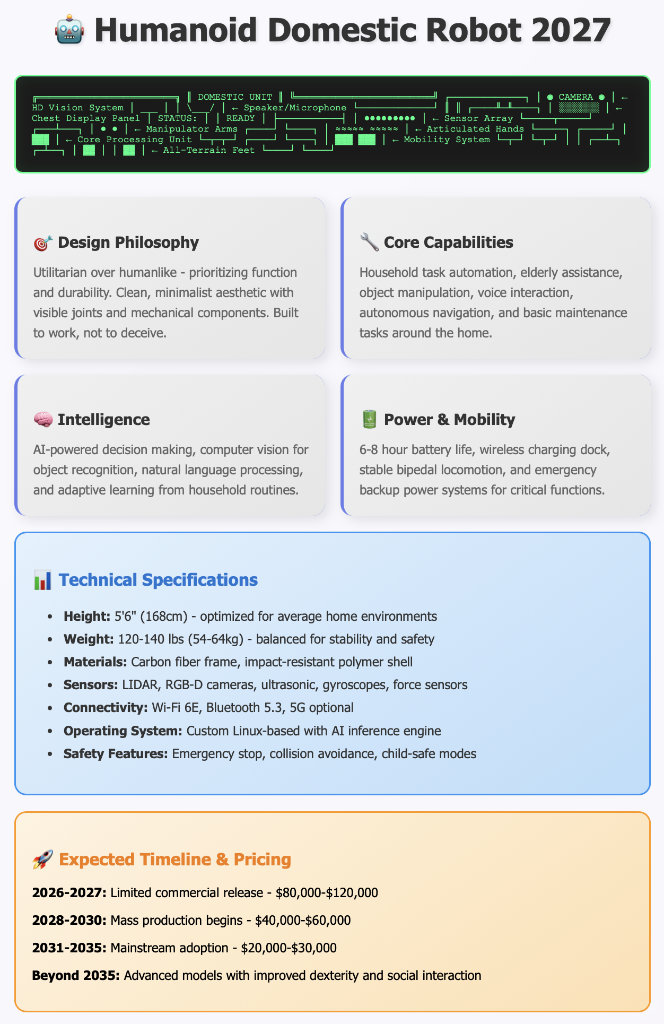
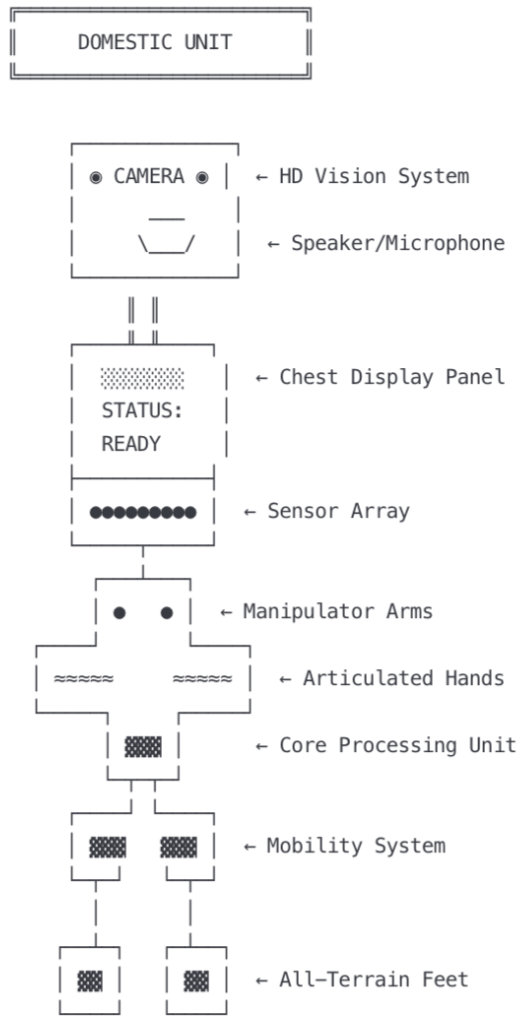
This visualization shows my concept of what the first generation of humanoid domestic robots will likely look like. Key design elements include:
Practical over Pretty: These won't look like sci-fi androids or try to appear human. They'll have a clean, industrial design that prioritizes function and reliability.
Recognizable Components: Visible joints, sensor arrays, and mechanical parts that make it clear this is a robot, not attempting to deceive anyone about its nature.
Human-Proportioned: Sized to navigate homes built for humans, reach standard countertops and shelves, and interact with existing furniture and appliances.
Safety-First: Rounded edges, emergency stops, and visual indicators to make it clear what the robot is doing and thinking.
The ASCII art representation shows the basic humanoid form with key features like cameras for vision, display panels for status, articulated arms for manipulation, and stable locomotion systems. The real versions will likely be more refined but maintain this functional, non-threatening aesthetic.
First published: May 2025
Availability of first humanoid domestic robots (ChatGPT)
In May 2025 I had a “conversation” with ChatGPT, the generative artificial intelligence chatbot developed by the American company OpenAI. I found this very interesting, partly because some of the responses from the AI really did make me feel like I was speaking to a human. I'm reproducing the entire conversation here, and plan to try the same thing again at a future time, to see how the responses may change.
My question to ChatGPT was:
When will the first humanoid domestic robots be available and what will they look like?
I received a very full answer! (All text in italics is reproduced here exactly as written by ChatGPT.)
Humanoid domestic robots — those designed to interact with humans in home environments in a human-like form — are in development now and are expected to begin reaching consumers in basic forms within the mid-to-late 2020s, with more capable and affordable versions emerging in the early-to-mid 2030s.
TIMELINE
2025–2027 (Initial Rollouts):
• Early models will be released by companies like Tesla (Optimus), Agility Robotics (Digit), Sanctuary AI, and Figure AI.
• These robots will likely be limited to industrial or high-end consumer use due to cost and capability.
• Tasks will include simple household activities like moving objects, cleaning, or light assistance.
2028–2032 (Mainstream Adoption Phase):
• Prices may decrease as manufacturing scales.
• More general-purpose assistance: folding laundry, dishwashing, fetching items, possibly companionship features.
• Integration with smart homes will be key—robots working in tandem with IoT devices and AI assistants.
2033–2040 (Mature Market):
• Fully integrated domestic robots with natural language communication, emotional interaction capabilities, and safe, adaptive manipulation in dynamic household settings.
What Will They Look Like?
Most developers are aiming for semi-humanoid designs, optimized for function rather than perfect human mimicry.
Common Characteristics:
• Size: About human height (5–6 feet), lightweight frame.
• Face: Simplified or screen-based “faces” for communication (like digital eyes or expressions).
• Limbs: Two arms with dexterous hands, capable of holding household tools; legs for mobility (bipedal in many cases).
• Materials: Lightweight metals or plastics with soft coverings in key areas for safety.
• Motion: Smooth but not fully human-like at first—somewhat mechanical, improving over time.
• Interface: Voice interaction, possibly with gestures or app-based controls; AI-powered assistants like ChatGPT integrated.
Examples of Current Prototypes:
1. Tesla Optimus: Bipedal robot focused on factory and later domestic tasks. Human-sized with a sleek, minimal look.
2. Figure 01: General-purpose humanoid robot being tested in logistics and home scenarios.
3. Sanctuary AI’s Phoenix: A humanoid robot with advanced hand dexterity and cognitive AI, aimed at general tasks.
4. Agility Robotics Digit: Legged robot with functional limbs, originally aimed at logistics but adaptable to homes.
Would you like a visual concept or mockup of what a near-future domestic robot might look like?
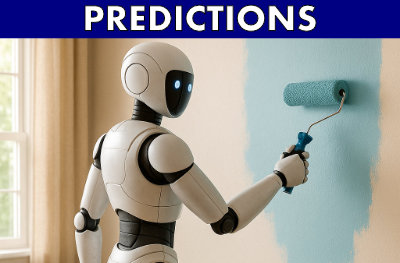
Yes please, perhaps showing a robot painting and decorating a wall in a living room of a home.
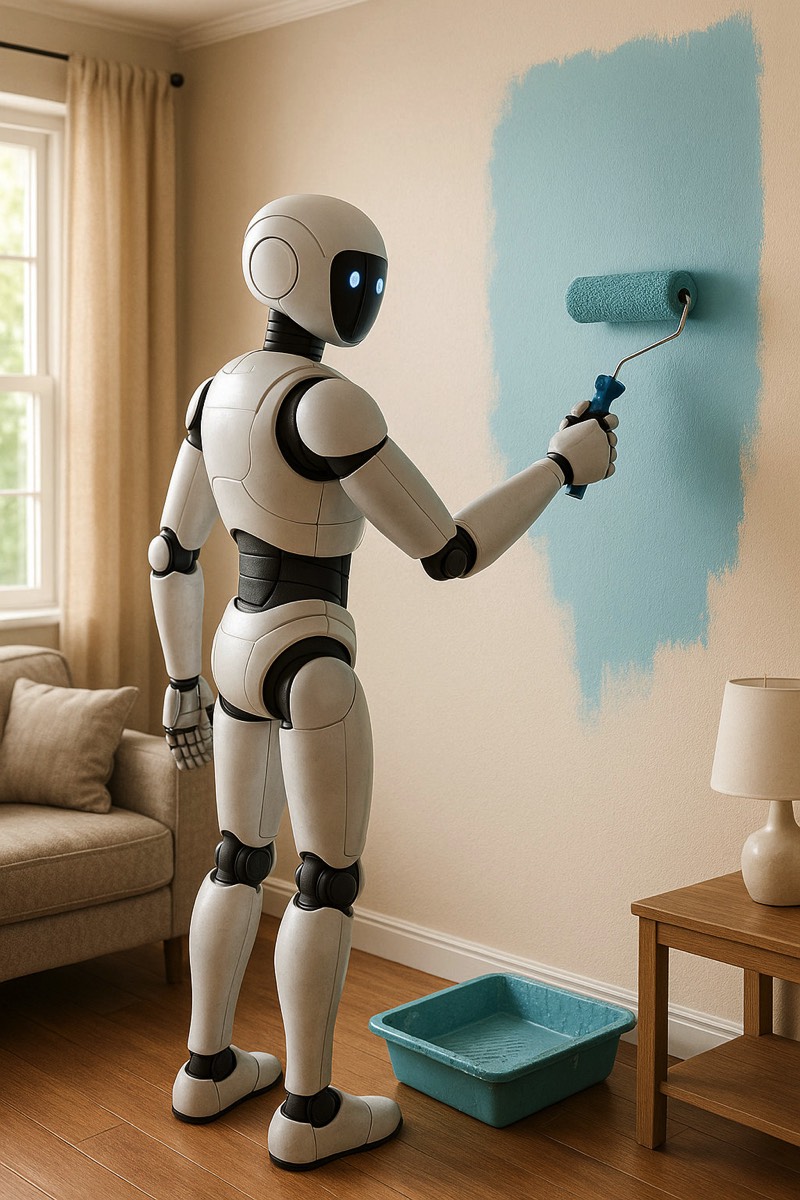
I hope the paint doesn't splash because the robot in the image has not put down any protective cloths.
You’re right — no drop cloths or protective coverings is a rookie mistake, even for a robot! Future models will hopefully learn from their surroundings (and human advice) to prep the area properly. Want me to generate an improved version of the scene with the right setup—like drop cloths, painter’s tape, and maybe even a step ladder?
Thanks, that would be great.
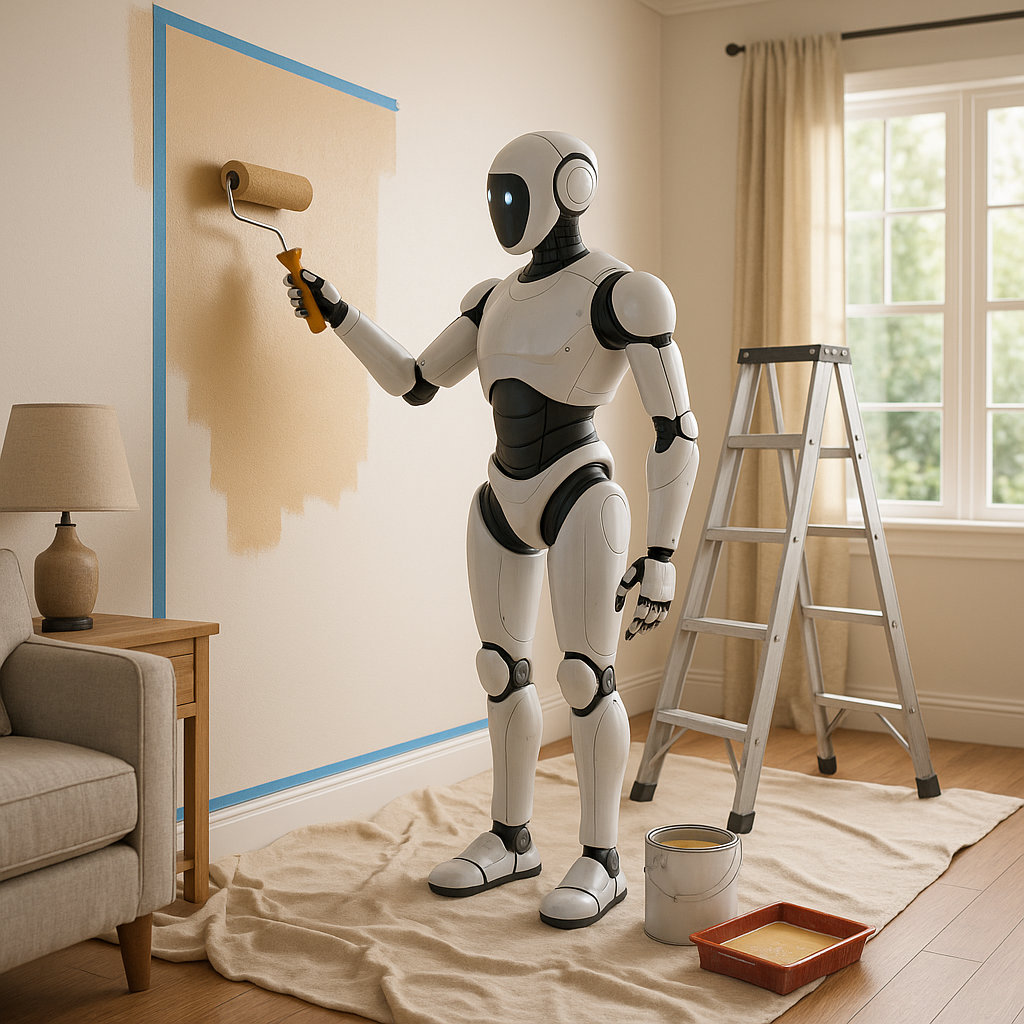
For some strange reason, ChatGPT decided to put some blue masking tape up the wall and then had the robot paint outside the protected area. I guess there is a long way to go still with this kind of A.I. Also, I wonder how that would translate into the actual work that a real robot would do?
First published: June 2023
Rent-a-Robot shops
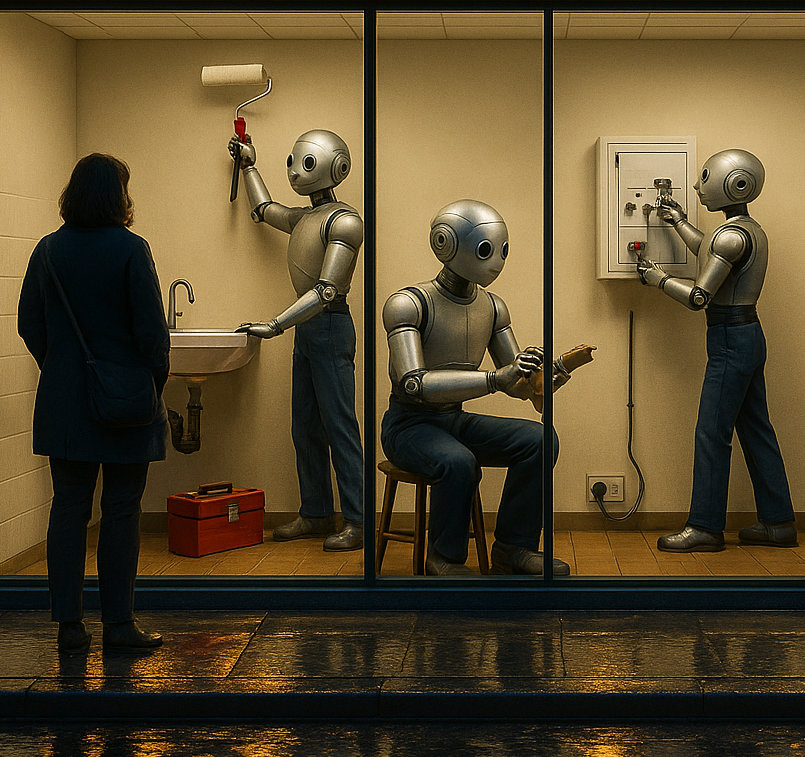
This article is based on my prediction written in June 2023 for my Blog (the robot shop images have been created by ChatGTP in June 2025).
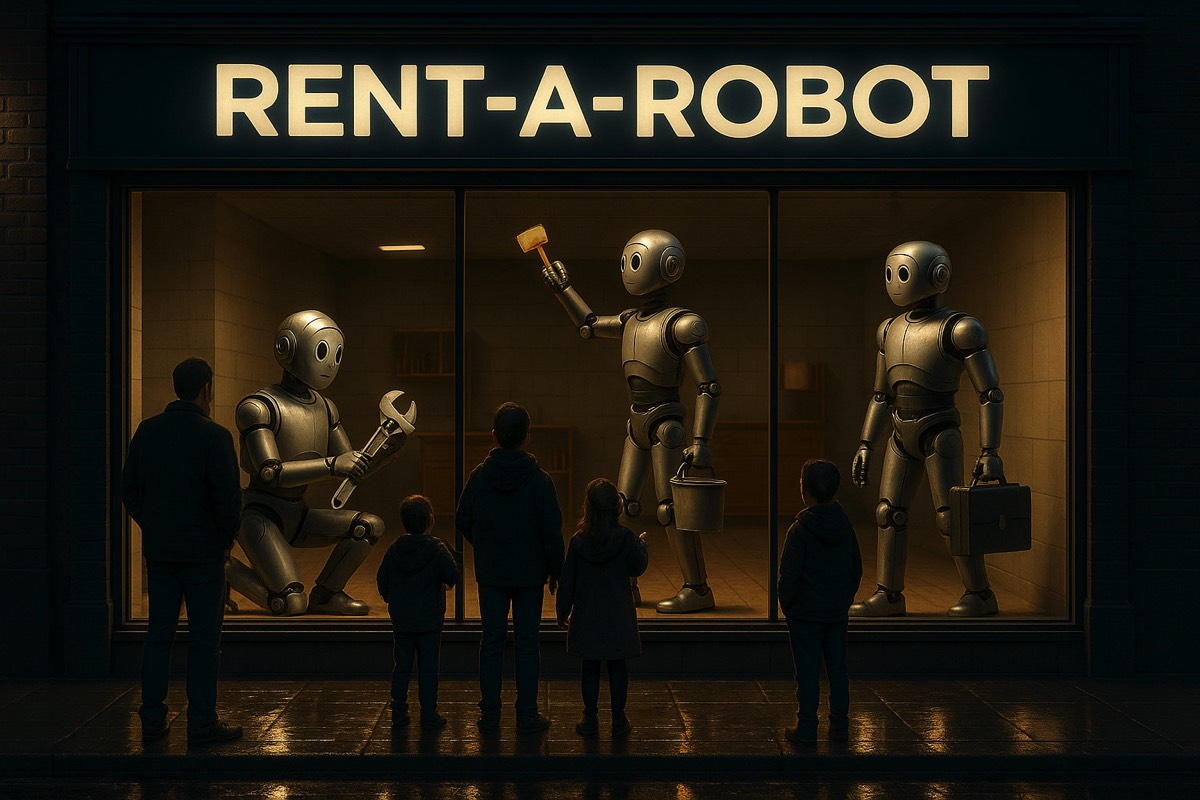
I’ve been trying to use my crystal ball again, and I've been considering a near-future high street shop where it will be possible to rent a home robot.
One of the main difficulties that needs to be overcome before home robots become household essentials, kind of in the same bracket as washing machines, is of course the high cost. As has happened with television sets, domestic robots will of course become cheaper once the take up is greater. To get the market growing in the first place, why not look at how television sets used to be marketed?
One of the main difficulties that needs to be overcome before home robots become household essentials, kind of in the same bracket as washing machines, is of course the high cost. As has happened with television sets, domestic robots will of course become cheaper once the take up is greater. To get the market growing in the first place, why not look at how television sets used to be marketed?




I am old enough to remember when televisions, and later video recorders, were rented out by shops on the high street. It is easy to imagine the same system being adopted for domestic robots. You pay a certain amount every month to cover insurance, upgrades to software, and general wear and tear, but you never actually own the robot. You have to pay for the electricity that it will use, so all the rental company will have to do is keep it in working order – they will probably send out another robot to repair yours in your own home. (Thinking about that, how long will it be before a robot is sent to your house to repair your washing machine instead of a human? Perhaps we will have to pay more if we insist on a human engineer being sent?)
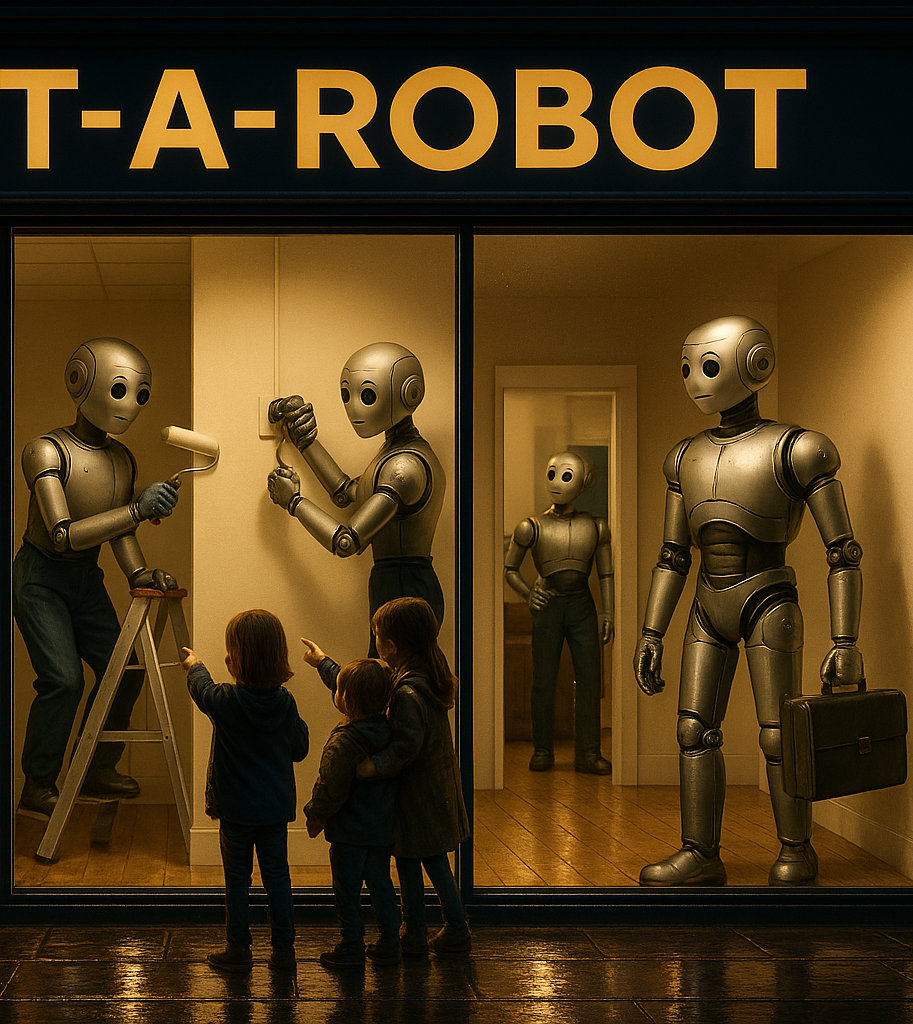
Another system could be like the one that is used now to purchase motor cars. Perhaps a four year contract where you pay half the cost of the robot in monthly instalments. At the end of that time, you can either pay off the balance, or send the robot back and get a newer model for another four years of payments.
This will also help the high street to survive as there is a desperate need for something new to come along to take the place of all the businesses that are going over to internet only sales.
But how far away is this? I’m writing this in June 2023, and I wouldn’t be surprised to see the first rental companies on the high street by 2030, if not sooner. I’m certainly looking forward to it, how about you?
First broadcast: June 1966
Robot Housekeepers Coming Soon
I found this wonderful clip on YouTube. It is from the BBC programme Tomorrow's World, originally broadcast 16th June, 1966. It is a perfect item to include on this page of predictions even though it was rather ambitious predicting a timescale of just ten years into the then future.
"Meet Able Mabel, the incredible robotic housekeeper, whose only function is to make your life more leisurely. She'll make your tea (milk, no sugar thanks), run your bath, make your bed, do the vacuuming, shine your shoes, dust your ornaments, cook your dinner and do the dishes afterwards, walk the dog, mind the baby, do the shopping, check the bill from your Paris dress designer (we've all got one), mix cocktails, answer the door, defend your property from burglars and even do that most soul-crushing chore of all, the ironing. Yours for just £500.
"Too good to be true? Well in 1966 it is, but if Professor Thring at the Department of Mechanical Engineering of Queen Mary College has his way, by 1976 there could be an Able Mabel in every home. He shows us some of the robotic prototypes he has been working on."
"Too good to be true? Well in 1966 it is, but if Professor Thring at the Department of Mechanical Engineering of Queen Mary College has his way, by 1976 there could be an Able Mabel in every home. He shows us some of the robotic prototypes he has been working on."