1928: Men of Metal!
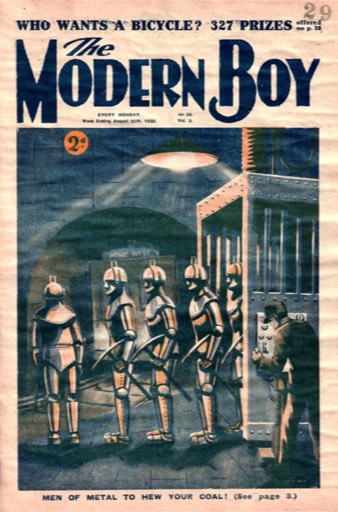
This article is reproduced in full from The Modern Boy, a weekly magazine, published for the week ending 25th August, 1928 (Volume 2, number 29).
"Will the World’s Workers of the Future be Wireless Controlled Mechanical Men? They have existed in the Pages of Novels for years past, and now an Automaton that Works to Orders has been Actually Invented!"
Always when a bit of clever machinery has been invented and applied to some manufacturing process there have arisen pessimists who have declared that the mechanical worker will throw several men out of work, that the machine will make of them just surplus souls with nothing to do.
And always that has proved false. The latest invention in the way of machinery has completely taken the wind out of the sails of the grousers, and it has astonished everybody. It is an almost intelligent mechanical man!
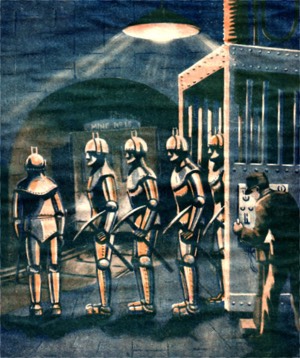
Our artist has depicted on this week’s cover his idea of possible future developments of the mechanical man. Set these men, says he, toiling at the hardest jobs in coal mines and thus liberate human miners for less strenuous work!
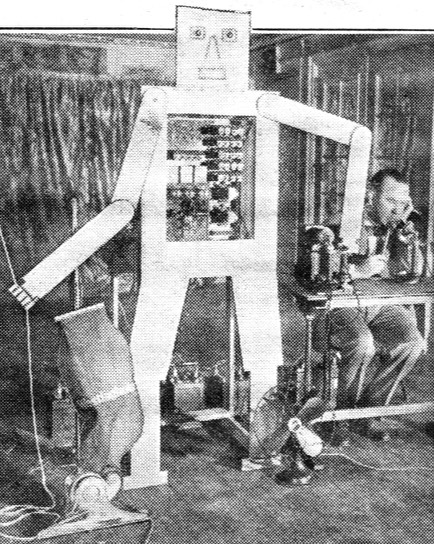
Dr. R. J. Wensley issuing telephonic orders to the mechanical man he has devised. The “man” is about to operate the vacuum cleaner by the side of his right foot.
The inventor of the mechanical man has not yet perfected his amazing apparatus to the extent of being able to set it at a job of work of that description, but it has done, and is doing, wonderful things enough.
He can speak, too!
His mechanical man can answer the telephone, use a vacuum cleaner, turn an electric light on or off, blow a horn, start or stop an electric fan, and even answer prearranged questions!
The bones of this man are porcelain, his veins copper, his “innards” a complicated mass of vacuum tubes, and he is electrically attuned to certain signals given by his master.
You will understand the arrangement better if you compare the mechanical man’s ability to respond to electric signals with your wireless set. You know you cannot get a certain broadcasting station on your set unless the set is tuned to “waves” of the correct frequency.
That’s how it is with our mechanical man. For every one of the jobs he is expected to carry out he is provided with a device which is tuned to a set signal. When he receives that particular signal the job which it concerns is promptly carried out by him. Simple – very, but marvellously fascinating!
He can even speak, in a passably life-like voice. Here the “talking pictures” device (which was explained in a recent number of ‘Modern Boy’) is brought into action.
The sentences he has to speak are “photographed” on to separate pieces of moving picture film, each about twenty feet long and fastened at the ends to make a complete loop. When he is expected to speak the film is set in motion by a small motor, controlled by the mechanical man’s master, and an arrangement of electric lamps and special lenses acting on the moving voice-film transmits the sentence to a small loud-speaker, which “gives tongue” into a telephone transmitter. And there you are!
His internal arrangements are therefore extremely complicated, but with that automatic voice of his he is likely to become very useful indeed. He can be operated at any distance, by telephone, and his usefulness is at present limited only by the lack of a brain and the fact that he will respond only to a few set orders with which both the mechanical man and the operator are familiar!
The mechanical man is the invention of a clever young engineer named Dr. R. J. Wensley, employed in the laboratories of Westinghouse Electric Manufacturing Company in America.
And now who is going to put the finishing touches to this marvel of 1928? Is it a job for you, at some future date, completely to transform the workaday world which draws us all to toil – much of which could be done as well, if not better, by a man of metal?
Really the idea behind the mechanical man has unbounded possibilities. Electric signals such as cause the present man of metal to perform set tasks and to give replies to certain questions are already being used in much the same way to operate lights on buoys and lighthouses.
Here the human element has been cut out entirely, daylight and darkness in turn regulating the flow of electric current – darkness causing the light to turn on in the lighthouse or on the buoy, the light being shut off automatically when daylight breaks.
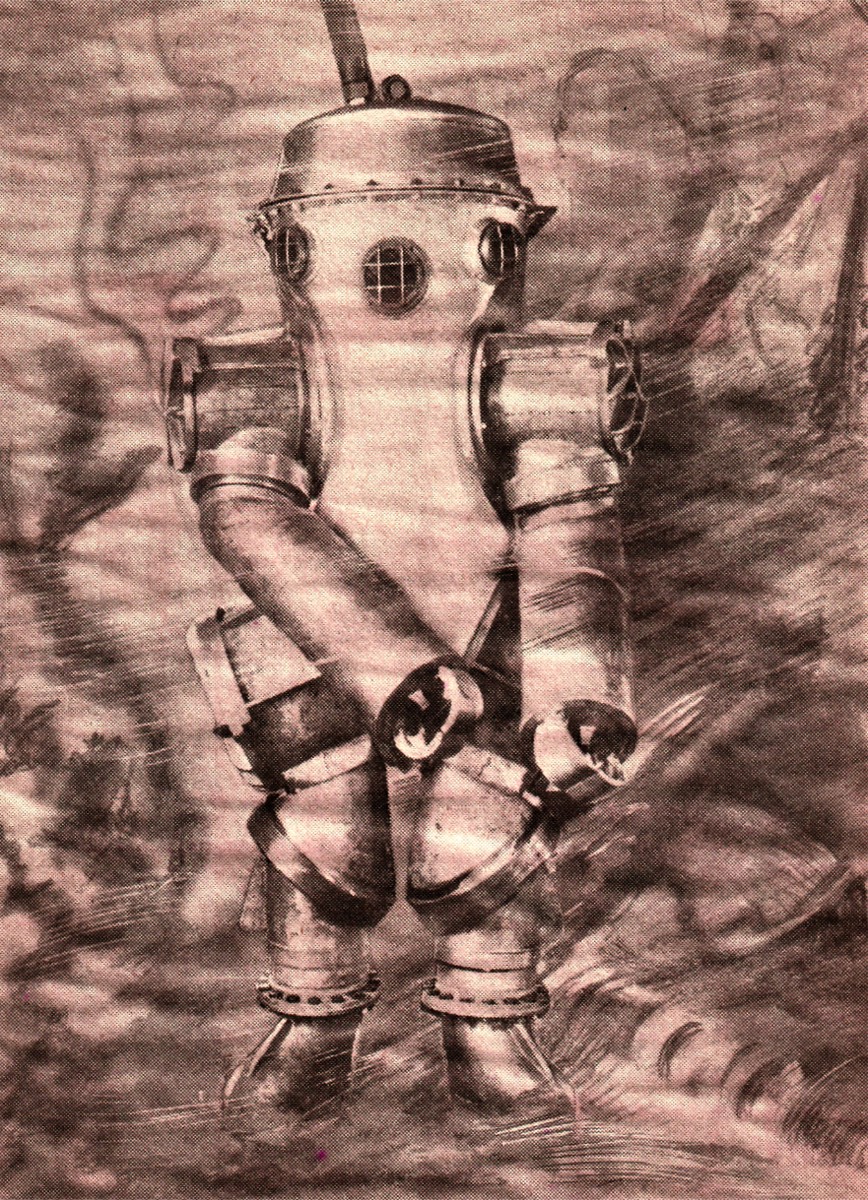
The Mechanical Diver!
Fathoms deep beneath the turbulent waters of the Atlantic, buried in the slime of the ocean’s bed, lies the Lusitania, the mighty liner that once sailed the seas between England and America and was sunk during the Great War. So deep does she lie that no diver has ever yet been able to get anywhere near her, but a new type of diving suit has been devised, made of steel and aluminium, and a fresh attempt is to be made to recover the bullion from her holds. The suit itself weighs three-quarters of a ton, but by means of the internal mechanism, the diver inside will be able to move about freely, using arms and legs in a perfectly natural manner!
Fathoms deep beneath the turbulent waters of the Atlantic, buried in the slime of the ocean’s bed, lies the Lusitania, the mighty liner that once sailed the seas between England and America and was sunk during the Great War. So deep does she lie that no diver has ever yet been able to get anywhere near her, but a new type of diving suit has been devised, made of steel and aluminium, and a fresh attempt is to be made to recover the bullion from her holds. The suit itself weighs three-quarters of a ton, but by means of the internal mechanism, the diver inside will be able to move about freely, using arms and legs in a perfectly natural manner!
Doing “impossible” work!
To get back to our purely mechanical man, the picture on the opposite page gives a splendid idea of the present trend of labour and fatigue saving invention, a mechanical man protecting and doing a good deal of the work of a real live man inside it – work which without the mechanical man’s aid would be quite impossible.
This mechanical diver is fashioned of steel and aluminium, of such stoutness that the enormous weight of water felt at considerable depths below the sea affect not at all the human diver encased within.
A supply of air for the diver to breathe, and a lighting outfit, are contained inside the mechanical man, and he – or rather it – is further equipped with grappling hooks of steel which are worked from within by the real diver and which take the place of he latter’s own hands and fingers!
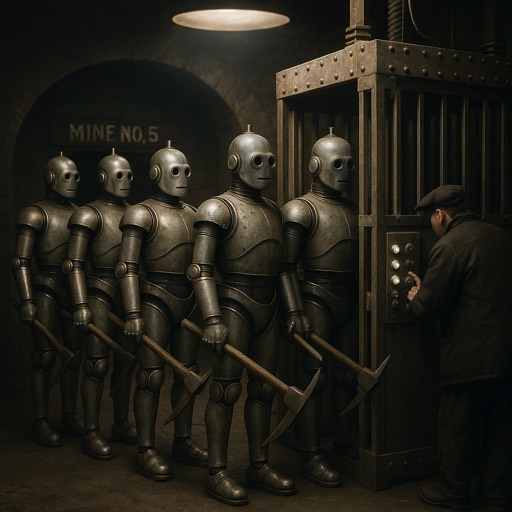
In June 2025 I asked ChatGPT to produce a photo realistic image from the drawing on the front cover of The Modern Boy. My instructions were, "Can you make this drawn image look photo realistic? Please retain as much of the original arrangement of robots as possible." In the first attempt, the robot miners looked more like knights in armour. So I asked for a revised image, "Please can you make the faces of the robots look more like robots, and all the same as each other. Also they should be facing the other way as if they have just exited the lift contraption. Each robot should be holding a pick axe for coal mining." ChatGPT didn't manage to make them face the other way, but everything else is pretty good. The robots do look a bit creepy though!
Links for further reading:
Herbert Televox, the Mechanical Man, Chicago, Illinois
https://drloihjournal.blogspot.com/2016/11/herbert-televox-mechanical-man-chicago.html
1927 – Televox – Roy J. Wensley (American)
https://cyberneticzoo.com/robots/1927-televox-wensley-american/
Herbert Televox, the Mechanical Man, Chicago, Illinois
https://drloihjournal.blogspot.com/2016/11/herbert-televox-mechanical-man-chicago.html
1927 – Televox – Roy J. Wensley (American)
https://cyberneticzoo.com/robots/1927-televox-wensley-american/
1700s: Automatons – ancestors of today’s robots
Fascinating accounts of Automatons go back centuries and demonstrate that human beings have always been fascinated by machines that can imitate humans. There is a very interesting Wikipedia page about Automatons from which I have taken the following story. I have no idea how accurate it is, but it is quite amazing if completely true.
In ancient China, a curious account of automata is found in the Lie Zi text, believed to have originated around 400 BCE and compiled around the fourth century CE. Within it there is a description of a much earlier encounter between King Mu of Zhou (1023–957 BCE) and a mechanical engineer known as Yan Shi, an 'artificer'. The latter proudly presented the king with a very realistic and detailed life-size, human-shaped figure of his mechanical handiwork:
The king stared at the figure in astonishment. It walked with rapid strides, moving its head up and down, so that anyone would have taken it for a live human being. The artificer touched its chin, and it began singing, perfectly in tune. He touched its hand, and it began posturing, keeping perfect time… As the performance was drawing to an end, the robot winked its eye and made advances to the ladies in attendance, whereupon the king became incensed and would have had Yen Shih [Yan Shi] executed on the spot had not the latter, in mortal fear, instantly taken the robot to pieces to let him see what it really was. And, indeed, it turned out to be only a construction of leather, wood, glue and lacquer, variously coloured white, black, red and blue. Examining it closely, the king found all the internal organs complete—liver, gall, heart, lungs, spleen, kidneys, stomach and intestines; and over these again, muscles, bones and limbs with their joints, skin, teeth and hair, all of them artificial… The king tried the effect of taking away the heart, and found that the mouth could no longer speak; he took away the liver and the eyes could no longer see; he took away the kidneys and the legs lost their power of locomotion. The king was delighted.
The king stared at the figure in astonishment. It walked with rapid strides, moving its head up and down, so that anyone would have taken it for a live human being. The artificer touched its chin, and it began singing, perfectly in tune. He touched its hand, and it began posturing, keeping perfect time… As the performance was drawing to an end, the robot winked its eye and made advances to the ladies in attendance, whereupon the king became incensed and would have had Yen Shih [Yan Shi] executed on the spot had not the latter, in mortal fear, instantly taken the robot to pieces to let him see what it really was. And, indeed, it turned out to be only a construction of leather, wood, glue and lacquer, variously coloured white, black, red and blue. Examining it closely, the king found all the internal organs complete—liver, gall, heart, lungs, spleen, kidneys, stomach and intestines; and over these again, muscles, bones and limbs with their joints, skin, teeth and hair, all of them artificial… The king tried the effect of taking away the heart, and found that the mouth could no longer speak; he took away the liver and the eyes could no longer see; he took away the kidneys and the legs lost their power of locomotion. The king was delighted.
I have included two videos from YouTube which show Automata that are still incredible to watch today. It is very hard to believe that these machines date from the 1700s. They are truly examples of early robotics and computing.